
AmaMpinga are the descendants of Mpondomise clan who originated from abaMbo group of people from The Great Lakes of Eastern Africa. AbaMbo moved from great lakes to settle for a long time near Zambezi River. From there they gradually moved to settle in the place which was called uMhlathuze in Swaziland and in Natal/Zululand. At this time AbaMbo were led by their king Sibiside, whose Great Place was at uMhlathuze near Swaziland near Dedesi River. During this time and place, this nation was called AbaMbo even its leaders were known as leaders of AbaMbo. Sibisides offsprings included Mavovo(father of Mkhize nations), Gubhela, Nomafu(father of amaBomvana) and Njanya. After the death of Sibiside. Njanya, Sibiside’s son took over as a king of AbaMbo nation and Njanya later gave birth to the twins Mpondomise (elder twin) and Mpondo. When Mpondo and Mpondomise grew up they left their home, each took his followers to start building their own nations and their generations and followers changed the name abaMbo to AmaMpondo and AmaMpondomise respectively. One of the reasons to separate was that together with their followers one day they went to hunt for a wild animal in order to get the skin to honour the elder twin as the hire to the Njany’s throne. The Mpondo group killed the animal and refused to give the skin to the Mpondomise group that is when the split between the twins started. Mpondo left home first (together with their Imfusi Xesibe) and took his followers along the Indian Ocean. Later generations of amaMpondo group occupied towns such as part of Port Shepstone, Bizana, Flagstaff, Lusikisiki, Ntabankulu, Libode, Port St Johns and Ngqeleni. It was King Cabe of AmaMpondo who first crossed Umzimkhulu River with his amaMpondo group and built his Great Place at IsiPhaqeni near Flagstaff. Xesibe group occupied the Mount Ayliff town. AmaMpondomise group moved to settle between amaMpondo areas and uLundi Mountains. Later generations of AmaMpondomise occupied towns uMzimkhulu, Kokstad, Harding, Matatiel, Mt Fletcher, Ugie, Maclear, Tsolo, Qumbu, Mt Frere and part of Mthatha. Mpondomise gave birth to Ndunu who gave birth to Sikhomo, who gave birth to Njanya(II) and who gave birth to Malangana. It was King Malangana together with his uncle Rudulu (another son of Sikhomo) who took AmaMpondomise to cross the uMzimkhulu River for the first time and settled at Bisa near the Ingele Mountains between Mt Ayliff and Mbizana.
AMARUDULU ARE PART OF GROUP OF AMAMPONDOMISE PEOPLE
About Rudulu, there are some amaRudulu who can be found in the amaXhosa area across Mbhashe river. Those are the generations of Rudulu who are not Xhosas in origin. The story said when the brothers and leaders of amaXhosa Tshawe and Cira were fighting who was supposed to be the king of amaXhosa, Tshawe came to amaMpondomise to come to help him. The King of amaMpondomise of that time ordered amaRudulu to go and help Tshawe to fight his brother Cira. 1.
AmaRudulu went there and helped Tshawe to defeat Cira and Tshawe won the battle. It is said when amaRudulu were fighting they used to praise themselves saying “we are the men of Sikhomo” (*Thina sizizinto zika Sikhomo”). Tshawe gave them the land there to continue to protect him so that they could not go back to Mpondomise area. Also Tshawe named his grandson by the name Sikhomo in recognition of what amaRudulu did. As you can see lineage of Tshawe, his son Ngcwangu and Ngcwangu is the father of Sikhomo and Sikhomo father of Togu, Togu father of Ngconde, Ngconde father of Tshiwo, father of Phalo, Phalo father of Gcaleka and Rarabe.
MALANGANA AND NTOSE ERA.
In the previous sections it was stated that Malangana was the first King of amaMpondomise who crossed Umzimkhulu River and settled at Bisa Near Ingele Mountains. He loved hunting and his dogs were so brave that they could kill any type of a wild animal. After he settled across Umzimkhule he tried to go futher and went as far as Ladyfree in abaThembu area near the Chizela River. His praise singer (imbongi) used to say “ ngunolanga langen’endlebeni yendlovu, nguDyamfu wase Chizela, uNongwe’yadl’ ithole…”. When Malangana died he left his son Ntose as the leader and king of amaMpondomise. Malangana fathered Ntose and Ntose fathered four sons Ngcwina, Cwerha, Mpinga and Debeza from different houses of wives. It must be noted that Ntose had many wives more than seven, but we only mention those four house with special official names and significant cultural symbols and duties. Ngcwina became the heir to the throne of Ntose as a King of AmaMpondomise and he (Ngcwina) took amaMpondomise Nation to Matatiel to build his Palace there exactly where Mvenyane School is currently situated (at the time of writing this history). All Ntose sons left Mbizana to different places together with their followers(as Chiefs and leaders of their followers). Prince Cwera took his followers to Ntabankulu, Prince Mpinga went to Qumbu with his followers and also Debeza took his followers to Qumbu as well.
NGCWINA ERA AS A KING OF AMAMPONDOMISE
Ngcwina as a king of amaMpondomise had seven wives, they gave birth to the following sons who eventually became their Mpondomise clans: Bhukwana, Nxothwe, Zumbe, Ngcinase, Cirha, Ngcitshane and Dosini. Of the seven wives, the most notable ones are the two namely the wife (Mangxangashe/Mthwakazi) who gave birth to Cirha and the wife (Mangutyana) who gave birth to Dosini. Dosini was supposed to be the heir to the throne of Ngcwina, but he lost his position to Cirha due to his behavior (Tyabashe, et al 1967 & Snanathelo, 2019). The AmaMpondomise Kingship Structure is as follows:
AMAMPINGA
Let us now come to Mpinga as the father and ancestor of all AmaMPINGA Clan. Mpinga had more than one wife, he had the great house from which he fathered Twins Mawawa and Phahla, imfusi Mbhusha (the child coming after twins is called imfusi). He had other houses where he fathered Madubane, another house he fathered Ntsikhwe and Ntsikhwazana (a girl who has her generations under the Mpinga Clan), another house he fathered Debeza and another house fathered Mpehle. All these houses (Mawawa, Phahla, Mbhusha, Madubane, Debeza, Ntsikhwe, Ntsikhwazana, and Mpehle) might have had their own generations as descendants from Mpinga. Mpinga is a descendant of AmaMpondomise clan who are the descendants of AbaMbo origin:
The structure of Mpinga generations starting from uNtu is as follows:
It is said Mpinga had six wives some of his sons namely (Mawawa , Phahla & Mbhusha) are from the one same Mpinga’s wife, Also uNtsikhwe and Ntsikhwazana from another same wife of Mpinga. AmaMpinga who can be found in the whole of South Africa and outside are from these different houses. Their clan names start from and include Mpinga, but some can add names of their various houses. There may be other houses from other wives that we have not mentioned or not aware of. Some clan names of amaMpinga were derived from the events or true stories that happened to Mpinga. Mponomise was a twin brother of Mpondo and their young brother(infuse was Xesibe. They were the sons of King Njanya of abaMbo. Cwera, Ngcwina, Debeza and Dombo were the brothers of Mpinga (half brothers because they were from different wives of King Ntose of AmaMpondomise). It was Ngcwina who became the hire of the Throne as a king after the death of King Ntose.
THE NTOMNTWANA STORY AND DREAMS OF NGCWINA THAT LED TO MARY UMTHWAKAZI
The story that led to the name Ntomnwana is as follows: King Ngcwina whose Palace was in Matatiel liked very much hunting on numerous occasions he used to dream of men coming from hunting carrying an animal without fur. These dreams worried him to such an extent that one day he ordered his men to go and hunt in the forests of Ingele Mountains in Mt Ayliff to check the meaning of his dreams. The men went to hunt for three days and on the third day they heared dogs barking looking at the the cave and when they went closer they found a bushman girl(umthwakazi). They took the girl to the king’s Palace and it was confirmed that the dream of the king was fulfilled. Then the girl was kept at palace together with other females who were the cooks for the king. It was later noticed that the girl (uMthwakazi) had special skills in cooking and was immediately assigned to cook for the king alone. Later it was noticed that the girl was pregnant and when asked she could not answer but just pointed up. It was then realized that the girl was impregnated by the king. Then people of high level were called (summoned) including Mpinge where he stayed to discuss the issue. Mpinga defended the king by saying that “once a girl has a pubic hair it is ready to meet a man”, (“into yomntwana ingaba noboya seyilungele amadoda”). Hence Mpinga was nicknamed “Ntoyomntwana”. The king ended up marrying umthwakazi and process of lobolo is another long story but it ended with eight black cattle (iinkabi). Mpinga was onceattacked by a lion and he faught the lion and managed to kill it, but the lion imputated his leg and he was left with one leg. After that he was commonly known as “Mleenze”.
MPINGA ATTACKED BY A LION AND MBHALA’S DEATH AT NGXINGXOLO
Again there is a story about Mpinga that he was once attacked by a lion and he fought the lion and it cut his leg (umlenze) before he killed it and because he had one leg he was also nicknamed “Mlenze” (pronounced Mleenze). Hence some of amaMpinga clan names will include Mpinga, Mawawa, Ntomntwana, Mleenze…etc. Hence there is place at eMbalisweni in Qumbu which is called e Bhubesini (place of a lion). Mpinga also lost his chieftainship position at that time and his land was taken away from him also the death of a certain magistrate by the name Hope affected Mpinga’s status and position. After these events amaMpinga disbanded and moved to different areas. Some went to Xhosaland, others to Pondondoland such as Bizana and Ntabankulu and others to Thembuland. Mpinga’s land as a chief was taken and made to be ruled by amaMpondo aseNyandeni. One of the most important events happened to one of the generations of Mpinga called Mbhala (the son of Nkqoshe) who died at Ngxingxolo falls in Mooiplass on the 10 October 1778 together with King Gcaleka of amaXhosa (whom he was his inyanga & advisor). As a result this day was agreed by amaMpinge to be the Annual Heritage Memorial Day of all the Heroes and Heroines of amaMpinga.
UMANYANO LWAMAMPINGA
AmaMpinga formed Umanyano Lwampinga and during the years from 2014 decided to build a Heritage Home for all amaMpinga at KwaVetyu in the District of Engcobo in the Eastern Cape. One of the aims of forming uManyano LwamaMpinga was to get the true history of amaMpinga and to restore the land of Mpinga. It was through this Umanyano LwamaMpinga that the Spirit of Mbhala was brought home to this Heritage site in 2016 when amaMpinga came all over South Africa to witness that historic event. Hence amaMpinga agreed to have a Memorial Day for uMpinga every year on the 10th October (first Saturday after this date). Umanyano lwamaMpinga has a National Leading Structure of eight executive members: The National Chairperson, Two Deputy Chairpersons, The National Secretary and Deputy Secretary, The National Spokes Person, The National Treasurer and the National Youth Coordinator. On top of these eight executive members it has traditional chiefs of amaMpinga, iingwevu zamaMpinga (amagqala/amagora) and representatives of Districts all together this structure forms what we call the Management Committee of Umanyano LwamaMpinga. In order to administer and visit amaMpinga, South Africa is divided into five Mega Regions namely The Easterm Mega Region, Southern Mega Region, Central Mega Region, Western Mega Region and Enock Sontonga Mega Region.
This day was agreed to be called Memorial Heritage Day of All AMAMPINGA. The most popular events to be celebrated on this day include the following:
- The Great achievements by uMpinga for producing such a Big Nation.
- To remember the events that happened to u Mpinga and remind the new generation of amaMpinga
- Our unity as amaMpinga and formation of Umanyano LwamaMpinga.
- Our Achievements as Umanyano LwamaMpinga that include, forming our website, building our heritage home at amaMpinge site.
- Inkosi Zwelenqaba Dungulu gave amaMpinga a big land in gratis to build their heritage home.
- Remembering and Celebrating our Heroes and Heroines such as Enock Sontonga the Author of SA National Anthem, Mbhala who died at Ngingxolo, Happyboy Mgxaji our great Boxer, Alger Mvicane our Great Singer and the others. Please also look the list of Amagorha ethu in this site.
- Discovering and writing our History that includes knowing that the origin of all amaMpinga is at Embalisweni at Qumbu in the Eastern Cape.
- These annual Celebrations are done only in one of the two sites namely, at Embalisweni at Qumbu and Kwa Vetyu at Engcobo.
CONSTITUTION OF AMAMPINGA
Amampinga drafted their own constitution that governs Umanyano LwamaMpinga explaining the following important topics
1, Name Association (2)
2, Aims and Objectives (3.1 & 3.2)
3, Legal Status (4)
4, Non-Profit Character and Income (5)
5, Powers (General Meetings, Management Committee & National Executive Committee) (5).
6, Membership (no joining fee, 8.1-8.5).
7, Financial matters (9.1-9.3)
8, Amendments to the Constitution (10).
9, District and Regional Structures (11).
10, General Meetings and Quorum (12).
11, Prohibited Conducts and Corrective Measures (31.1-13.2).
12, General conduct expected from the members of the association (14).
13, National meetings and head office (15).
14, District, Regional and Local Meetings (16).
15, Preparations for the general meetings, financial contributions etc. (17.1-17.3).
16, Religious Recognition (18).
17, amaMpinga Annual National Heritage Day (19).
18, Traditional Regalia or Attire (20).
19, Official Website (20.1-20.2)
20 Advertisement and Marketing of amaMpinga Business (21).
21, AmaMpinga National Prayer (22)
22, procedure for winding up (23.1-23-
23, Adoption (24)
24, Signing/Signatures (25)
NAME AND/OR SURNAMES OF AMAMPIMGA ACTIVE IN FORMING AND ADVANCING Umanyano
Majikija, Ndude, Mbiza, Dungulu, Noqamza, Manana, Nqevu, Mbhawuli, Mantambo, Kiza, Songwiqi, Mahlasela, Krabaza, Vutha, Qasha, Spatala, Jikijela, Goqweni, Mhlana,
UMTHANDAZO WAMAMPINGA
NKOSI SIKELELA AMAMPINGA KWINZAME NEMIGUDU YAWO, YOKUQOKELELANA ABUMBANE NGENJONGO YOKUMANYA OLU HLANGA. WANGA UQAMATA ANGAWAVIKELA AWAKHUSELE, KUBAPROFETTHI BOKUNGENDAWO NABACHASI BENKQUBELA PHAMBILI. YANGA IMITHANDAZO YAWO NEZICELO ZAWO ZINGAYIMPUMELELO, YANGA IMIZAMO YAWO INGAYIMPUMELELO, IBE NGUMZEKELO KWIZIZWE NGEZIZWE. KHONUKUZE LIPHILE IHLABATHI. SITSHO SINGAMAMPINGA EGAMENI LIKA THIXO. UTHIXO UYISE OWADALA ULUNTU LONKE, UTHIXO UNYANA OWASINDISA ULUNTU LONKE, UTHIXO UMOYA OYINGCWELE ODLISA UBOMI NOMNIKI WOBULUMKO BONKE. MAKUBENJALO NGONAPHAKADE. “AMAMPINGA, ALL FOR ONE AND ONE FOR ALL!
AMAMPINGA PRAYER
GOD BLESS AMAMPINGA CLAN IN THEIR ENDEAVOURS AND RESOLVE TO REACH TO ALL KNOWN MEMBERS OF THIS CLAN, WITH THE SOLE AIM OF UNITING IT. MAY ALMIGHTY PROTECT THIS CLAN FROM THE PROPHETS OF DOOM, AND THE ANTIPROGRESS GROUPINGS AND MASTERS OF PULL DOWN SYNDROME. MAY THEIR PRAYERS AND REQUESTS BE ANSWERED. MAY THEIR ENDEAVOURS BE A HUGE SUCCESS, SO THAT IT CAN BE EXEMPLARY, AND IMITATED BY BY THE NATIONS IN THE WORLD, SO THAT THE ENTIRE UNIVERSE CAN GET AHEAD. SO SAY AMAMPINGA IN THE NAME OF GOD., GOD THE FATHER, WHO CREATED THE ENTIRE HUMANKIND, GOD THE SON, WHO SAVED THE ENTIRE HUMANKIND, AND GOD THE HOLLY GHOST WHO FEED LIFE, AND THE GRANTOR OF ALL WISDOM. FOREVER AMEN, “AMAMPINGA, ALL FOR ONE AND ONE FOR ALL!!!”
SAME AND SIMILAR NAMES THAT REFER TO DIFFERENT PEOPLE WHO ARE NOT RELATED AT ALL
- Malangana of amaXhosa who is the son of Xhosa and grandson of Mnguni.
- Malangana of ama Mpondomise who is the son of Njanya(ll) and grandson of Sikhomo
- Sikhomo of amaXhosa, who the son of Ngcwangu and grandson of Tshawe
- Sikhomo of amaMpondomise, who is the son of Ndunu and grandson of Mpondomise
- Sigcawu of amaXhosa who is the son of Sarili and grandson of Hintsa
- Sigcawu of amaMpondo who is the son of Mqikela and Grandson of Faku
- Faku of amaXhosa the son of Gonya and grandson of Sandile and great grandson of Ngqika
- Faku of amaMpondo the son of Ngqungqushe and grandson of Nyawuza.
- Cirha of amaXhosa, brother of Tshawe and son of Nkosiyamntu and grandson of Malangana.
- Cirha of amaMpondomise, son of Ngcwina and grandson of Ntose
- Cira/Cirha refers to the same person.
- Phalo of amaXhosa, son of Tshiwo and grandson of Ngconde
- Phahla (twin of Mawawa) of amaMpinga and son of Mpinga and grandson of Ntose.
- Phahlo of amaMpondomise, son of Ngwanya and grandson of Majola
- Debeza one of the sons of Ntose and grandson of Malangana
- Debeza one of the sons of Mpinga and grandson of Ntose.
- Mpinga/ Mpinge refers to the same person
- Mpondomise/Mpondomse refers to the same person
- Noqamza/Noqhamza refers to the same person of Bizana National Chairperson of Umanyano LwamaMpinga.
- Skhomo/Sikhomo refers to the same person
- Sontonga/Sontsonga refers to same person the author of SA National Anthem from aaMpinga Clan (Nkosi Sikelel’iAfrica).
- Njanya the son of Sibiside and the father of twins Mpondomise and Mpondo .
- Njanya (ll), (is the great, great grandson of Mpondomise) and the son of Sikhomo and the father to Malangana.
- Mditshwa of Tsolo: of amaMpondomise great, great Grandson of Phahlo.
- Mditshwa the great, great, great, great, great great-grandson of Chief Mzize at Bizana kwaMzize
ENGLISH/XHOSA/ZULU/PONDO/MPONDOMISE
MONTHS OF THE YEAR
ENGLISH XHOSA ZULU PONDO/MPONDOMISE
January EyomQungu Masingana uNtlolanja
February EyomDumba uNtlolanja uNdazosela
March EyoKwindla uMbasa umBasa
April uTshazimpuzi uNdasa uMgudlula
May uCanzibe uNtlaba uNtlangula
June iSilimela uNtlangulana uNtulikazi
July eyeKhala uNtulikazi uNcwabakazi
August eyeThupha uNcwaba uMfumfu
September eyoMsintsi uMandulo uMphanda
October eyeDwara uMfumfu uZibandlela
November eyeNkanga uLwezi uLwezi
December eyoMnga uZibandlela uNtshiga
XHOSA MPONDOMISE
UKUMBA UKOMBA
UKULUKA UKOLUKA
UKWEPHULA UKWAPHULA/UKOPHULA
UKWANEKA UKONEKA
UKWAYAMA UKOYAMA
IZINXONXO IZIFOTHO
ISUTHU ITHONTO
IGQWIRA UMTHAKATHI
UMLIMANDLELA UMVIKO
IKHALIPHA IKROTI
UKUXONXA UKUBUMBA
UKUZALA UKUGCWALA
UMBETHE IVUKAZI
THE LINEAGE OF MPINGA CHIEFTAINSHIP GENERATIONS
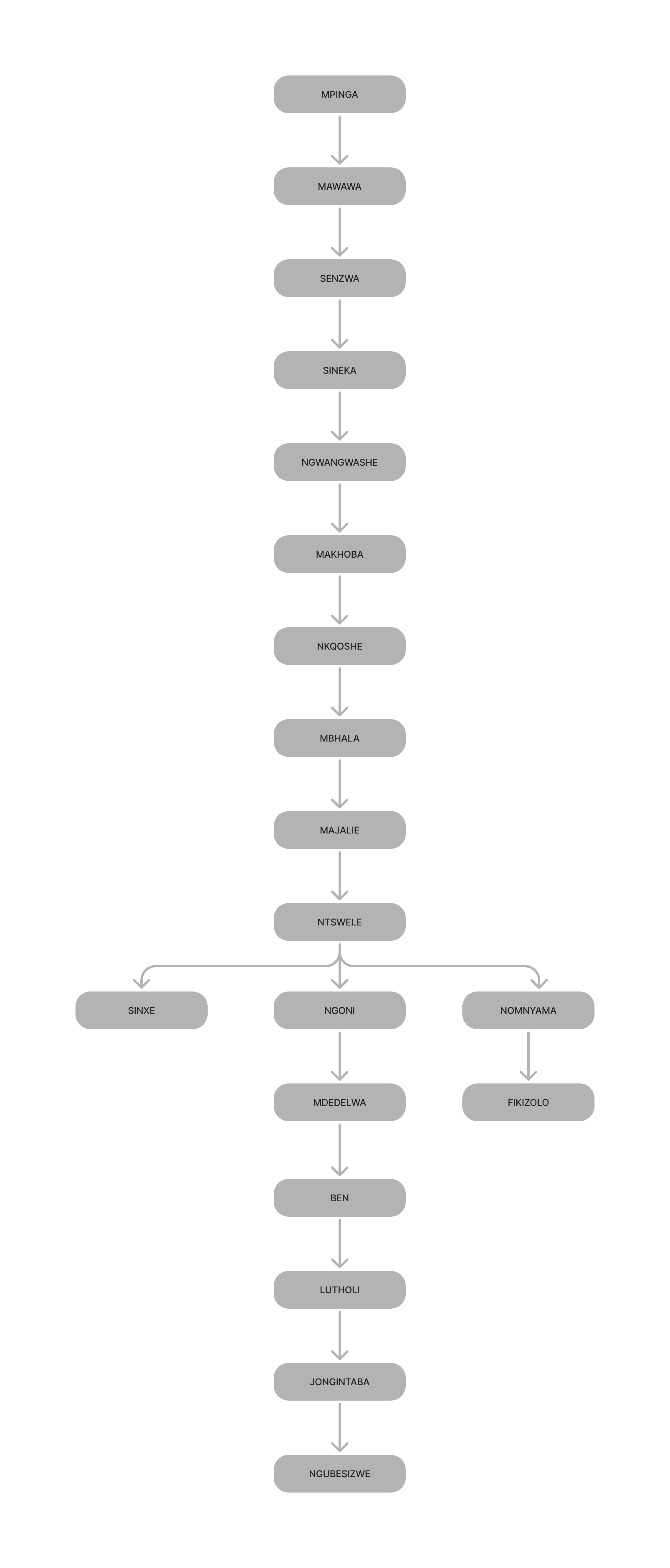
Turning to Mawawa who was the elder twin and who was born from the great house also entitled to the be the heir to Mpinga as a Chief of AmaMpinga. The great House of Mpinga is as follows: Mpinga fathered Mawawa fathered Senzwa fathered Ngwangwashe fathered Makhoba, fathered Nkqoshe, fathered Mbhala, fathered Majalie, fathered Ntswele, fathered Ngoni, fathered Mdedelwa, fathered Ben, fathered Lutholi, fathered Jongintaba, fathered Ngub’esizwe.
REFERENCES
1, AmaMpinga Annual Celebrations on Mpinga Heritage Day in October 2016. “ Mbhala Spirit is Taken Home From eNgxingxolo”),
2, AmaMpinga Elders of Embalisweni (iingwevu zamaMpinga), Oral and Written History Collected from the years 2014-2019.
3, Bhotomane,N; Biyela, U, Koko, M; Tyabhashe, M; Zenani,N, & Nongeenile, M.(1967) The South African Voices; The Way we Travelled: Oral History and Poetry. THE ORIGIN AND HISTORY OF AMAMPONDOMISE PEOPLE.
4, Bhotomane, N. & Zenani, NM. 1967. The Origins of AmaXhosa and abaThembu.
5, Mkhize, Siyabonga (2009). Uhlanga LwaseMbo. Sibiside Publishers,ISBN 978-0-620-43055-5
6, Mpinga, Senzwa. Even though this clan is so big it has a clear history of its origin. (http;//www.mpingasenzwa.co.za/index.php/history).
7, Ngcobo, N. & Ngcama, A,(1965): Iziduko and original History of AmaMpondo and AmaMpondomise People.
8, SA History Online. http.//www.sahistory.org.za/article/pondoland-revolt-1950-1961.
9, Sinanathelo, D. (2004). AmaMpondomise; Izibongo Izithakazelo Umlando Clan Names Iziduko.
10, Speech by Chief Zwelenqaba Dungulu (Mpinga) at the Annual Celebrations of amaMPINGA Heritage Day at Mbalisweni, 2019.
11, Soga, JH (1930). THE South African Bantu (Abe-Nguni, Aba-Mbo, Ama-Lala) Wits University Press. ISBN, 978—1-135-96334-7).
12, Tabane, M. & Mbana, N. (2014). AmaMpondomise nakwindlu kaKrancolo. Mana Desingns and Printing.
13, UKZN 2017 AbaMbo people history (http;//disa.ukznac.za/kywords/abambo-people-history)DISA. 6 April 2021.
14. Various Speeches by Dr L. Nqevu (as amaMpinga Spokes Person) and BM Ndude during amaMpinga gatherings since Umanyano LwamaMpinga was formed 2014….